COUNTERCULTURE
1968 WAS A KEY YEAR for the Sixties counterculture, highlighted by anti-Vietnam War protests on college campuses and the protest-to-end-all-protests at the Chicago convention:
1967-68-69 marked the peak of the American Cultural Revolution (yes, the U.S.A. also had one) which lasted from 1955 to 1973. A subject for a much longer essay.
THE POINT is that the college protests of 1968 were political, but also part of an entire cultural movement, which gave the demonstrations much of their strength. Music, styles, and mores had changed drastically. Culture was in upheaval– cultural revolution that’d been kicked off thirteen years prior by the roots musical explosion of rock n’ roll and by two Hollywood movies celebrating youth rebellion.
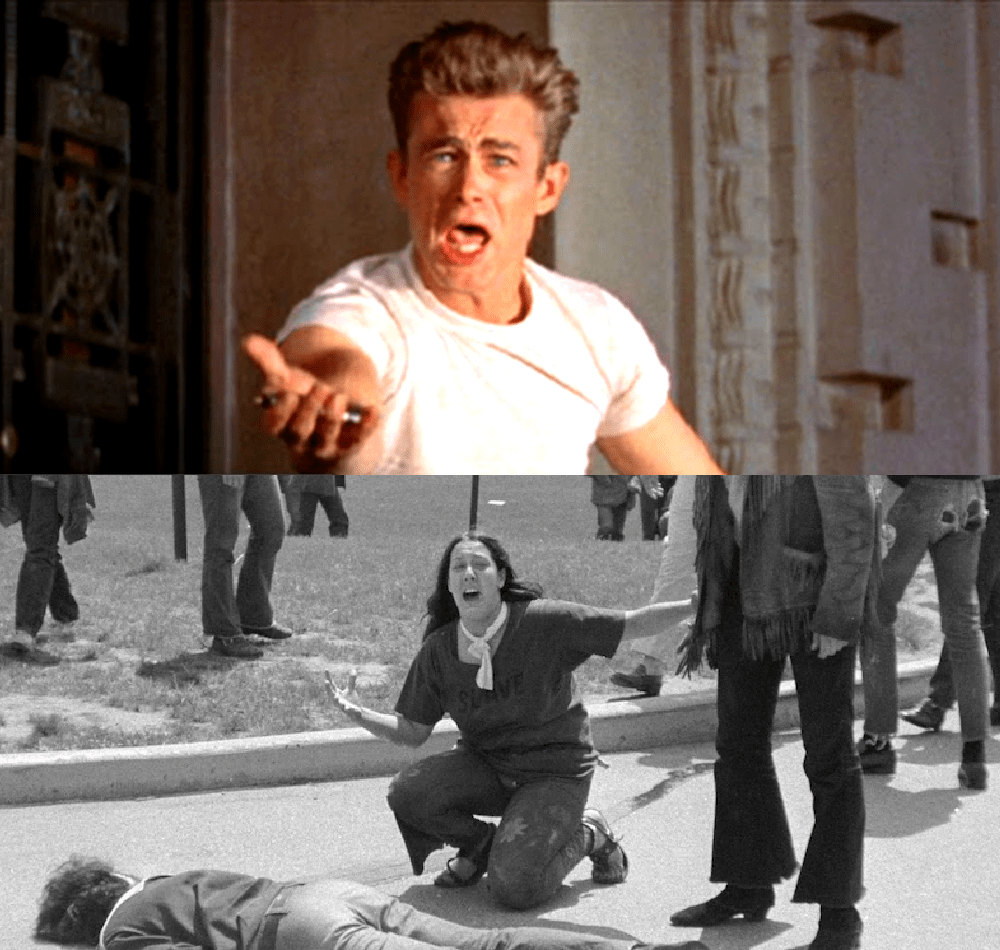
(“Rebel Without a Cause” 1955; Kent State 1970.)
An authentic counterculture was fully underway– rejection of handed-down homogenized standards combined with an embrace of new ways of living and thinking. Back-to-the-land artisanal small-scale attempts to escape the top-down corporate rat race, in search of independence and personal freedom.
They thought their world had become too conformist, too big, too intrusive– too unequal and stratified. Yet in its totalitarian get-in-your-head aspects that world carried a small fraction of the omnipresent technological intrusiveness of now.
If they had reasons to get out of their world– what about us?
Did the Sixties counterculture live up to its ideals and its promise? Of course not. But for a few years it sent shock waves through the technocratic system and the hierarchy-based U.S. establishment. Culture gave the campus protestors and convention demonstrators of 1968 a cachet– a glamor– they would not otherwise have had. Protest songs from Bob Dylan, Joan Baez, and those who followed them served as soundtrack to the seizure of university buildings and shouts of “Peace Now!” and “The Whole World Is Watching!”
For all the energy put into current political protests, among a host of mistakes they lack the force of a full-scale cultural assault.
It’s what’s also missing from pushback against the top-down megabillionaire-backed assault of AI-generated work and art– though artists of all kinds are among the most affected.
NEEDED: A brand-new counterculture disconnected from the bought-and-paid-for hierarchical institutions of today. More human ways of thought, creativity, and expression; of experiencing the world: the real, analog world. A return to what makes us human, to serve as a model for those completely trapped within, and owned by, the electronic hive.
An escape door. A way out.
-Karl Wenclas
Discover more from Fast Pop Lit
Subscribe to get the latest posts sent to your email.
