TWO MIDCENTURY DIMITRI TIOMKIN MOVIES
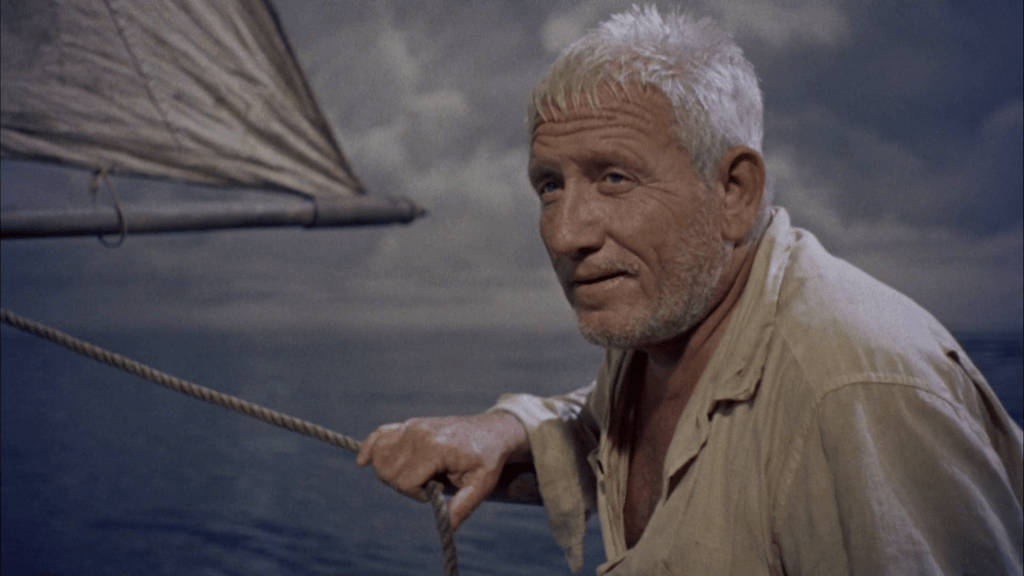
I call them Dimitri Tiomkin movies, because in both instances the movies are made by their impressionistic musical scores, as well as their natural settings.
The first of the two films is a 1958 version of Ernest Hemingway’s short novel The Old Man and the Sea, directed by John Sturges and starring Spencer Tracy. It’s a movie that sneaks up on you, in that at first you might be cynical about Spencer Tracy in the role, the voice-over narration and the film seeming to take the book too literally. Then the drama of the story kicks in, one man against a very large fish and against the elements, accompanied by wide-screen color cinematography. The story itself gives it depth and impact. But that evening so did something else. I watched it with NPL Contributing Editor Kathleen Crane amid a hostile early winter where we live. After being bombarded by the elements. After I’d been outside shoveling too-soon late-November snow. The images of weather on the screen had greater impact for me because of this. Funny how aesthetic elements and events outside the artwork impact one’s experience of it.
Impactful as well was the Dimitri Tiomkin score, which suggested the moving sea the movie’s character battled through. Impressionistic music has always been to me (think Debussey’s La Mer) the most naturalistic, in tune with nature, of all musical genres. Tiomkin won an Oscar for his score– which maybe that year should’ve gone to populist American composer Jerome Moross’s score for The Big Country. Tiomkin is my favorite all-time movie composer. I’ve long felt he deserves ranking with giants like Miklos Rozsa, Bernard Herrmann, John Williams, Erich Wolfgang Korngold, and whoever else.
ANOTHER FLICK

Not long after, we watched The Guns of Navarone. Having seen the restored version of the 1961 adventure film on the big screen in Philadelphia in the 2000’s, I was well familiar with Tiomkin’s score for that movie. The Question: Would the viewing experience of this film also be enhanced by the tumultuous weather raging outside our creaky house?
The Guns of Navarone is a work immersed in nature and weather, with the feel of a contemporary Greek myth to it. Dimitri Tiomkin’s score serves, along with the film’s images, as a key into the subconscious. Watching it is like experiencing a dream. The narrative throws a series of elements at the viewer, a parade of obstacles, including a raging storm, a 400-foot cliff that needs to be climbed, and a pair of giant German cannons which have to be taken out by a commando team someway, somehow. It’s all heroic, and Homeric. At the end, remaining members of the team are thrown back into the sea from whence they came. And yes, the natural elements we’d been experiencing, of cold, wind and snow, enhanced our experience of the film.
Art interests me aesthetically far more than intellectually. It’s what happens beneath and beyond the conscious intellect that strikes the deepest chords within us, is most moving. A phenomenon which established critics, for whom all is intellect, never seem to get.
-K.W.
Discover more from Fast Pop Lit
Subscribe to get the latest posts sent to your email.
