A WRITING CONTEST

A writing contest– sponsored by a local library. For teens and adults: poetry or short fiction or creative non-fiction. But read the rules!
(Michigan residents only– but you have time to move here!)
A WRITING CONTEST
A writing contest– sponsored by a local library. For teens and adults: poetry or short fiction or creative non-fiction. But read the rules!
(Michigan residents only– but you have time to move here!)
UPCOMING FICTION

This was a brain on fire. He’s seen plenty of brains on fire before. His own brain has always been a little on fire, too, and that’s how he’s sitting in this family office with fifteen employees overlooking the Pacific now. Okay, kid’s clearly brilliant. The question is always, which brains on fire do you go with, and which ones do you get as far from the flame as possible? After an hour, Mark couldn’t take it anymore. Got up, shook the kid’s hand, wished him luck, and dialed late into the board meeting of a steel mill in Louisiana they own a thirty percent stake of.
That night, though, he thought about Ahmet’s pitch again. It’s not that he recognized some of his own original ambition and eagerness and raw smarts in the kid – in fact he didn’t recognize much of anything about the kid – but the markets were at a carnival stage right then, crazy winds blowing through the circus tent, canvas flapping wildly, and he’d hate to miss the carnival entirely. So Mark called him – you can call anyone anytime, if you’re giving them seed money. Okay, what the hell, Ahmet. A lot of what you said makes sense. Some of it doesn’t, but maybe that doesn’t even matter right now. I’m good for three mil, and I’ll set you up with a couple associates of mine, we’ll help you get the fund to fifty to get us out of the gate.
Whereupon, Ahmet bought a ton of stuff that tanked instantly. Told you so, Mark was thinking. But Ahmet used a big portion to buy cryptocurrencies, which was outside the fund charter, drawing the instant ire of Mark’s fellow investors, who all simmered down as the crypto investment climbed, then soared.
COMING SOON to New Pop Lit!
NEW POETRY

It is a question of economics
where the price you pay gives you the best seat,
and the best seat gives you the best experience.
Train Life
It is a question of timing
where we will not announce platform changes
until three minutes before a train reaches you,
and the new platform is a full pelt run away
Train Life
It is question of chance as to whether or not
your carriage contains a group of school children in a shouting competition
or your carriage contains a group of babies in a crying competition
or a group of teenagers looking for like, an easy like man, stereotype.
Train Life
The man opposite you is raising his eyebrows,
his flares his nostrils as Lisa from accounts tells everyone
she is on the train.
Train Life
All the people.
So many people,
wanting to get home,
or to work so they can afford a home.
Train Life
reading the newspaper,
hoping for something other than
the same clowns in charge,
Train Life
leaves on the line
cold, insipid tea,
frost on the windows,
and the muffled clap of gloved hands,
the shuffle step of cold feet,
and an announcement saying the next train
is delayed for another ten minutes.
Train Life. . .
Ben Macnair is an award winning poet and play-wright from Staffordshire in the United Kingdom. Follow him on Twitter @benmacnair.
NEW FICTION

(image c/o the independent)
There’s a photograph from the 1990s of a city salt truck turned onto its side in a snowy ditch. Those who were there will recall it from glossy posters and keychains and silkscreened t-shirts. It was a bumper sticker on the Ford Escorts of that generation’s first high school girlfriends, the ones who picked up mothers’ sons and returned home men of certain experiences.
The popularity of the image came from its accidental perfection of storytelling: the history of the truck in tire skids; the driver’s panicked face as he leaned on the mound of salt gravity had evacuated from his vehicle. It spoke to our universal lack of control. The futility of man preserved in one lucky shot.
It was an image powerful enough to drive my parents to divorce and put my father permanently out of work. He was thirty-six the night he turned over that truck, the same as I am now. He entered the ditch with his bloodstream meff’d on Alival, Tryptanol, and the thorny bloom of gas station Wild Irish Rose. Three decades on, my own bloodstream sometimes begs for similar potions.
I’ve come to regard the photo as a kind of mandala—the ditch that represents the whole tight universe I’m destined to occupy. It’s a mnemonic to remind me just how badly the world can treat you. And because it’s been there to warn me, I’ve never been surprised—that I’m not as smart as I’d like, that I’m fatter than I was and thinner than I’ll be, that I’m under-employed, -sexed, and -appreciated. On and on.
There was a lack of fanfare when your mother left me, because I always assumed I’d end up alone. (And, in case you’re sentimental and believe it’s better to have loved and lost, I’ll remind you that when Tennyson wrote those words, he had a mortgage and health problems and was in desperate need of cash. He knew, as all desperate people do, that there’s no limit to the amount we’ll pay to pretend our second act will be better than our first. See, as evidence, those recent Frasier and Sex and the City reboots.)
So, why am I telling you this? Because you’re my son, and you should hear it from me: time is a flat circle. It pains me to say, but gramp-gramp’s failures, and mine, will be your failures too. The die has already been cast and, I’m sorry to say, little dude, that die is loaded against you. Welcome to the ditch.
That’s all I wanted to say. Okay, go on now. Have a good first day at school. Daddy loves you, kid.
****
M.C. Schmidt‘s recent short fiction has appeared in The Saturday Evening Post, Southern Humanities Review, EVENT, Coolest American Stories 2024, and elsewhere. He is the author of the novel, The Decadents (Library Tales Publishing, 2022) and the forthcoming short story collection, How to Steal a Train (Anxiety Press, 2025). He appeared previously at our main site, with the entertaining story, “We Love You, Ringo.”
NEW FICTION

Allison had been his personal assistant for two months. As long as anyone had lasted in the position, she’d been told by one of the security men, part of a phalanx of security men. The job was wearing. Simply being in the Advisor’s presence was exhausting. The man had a draining personality– a combination of brilliance and admitted quirkiness. He was always “on.” Like an actor on stage, but the stage never left him. Which was how he’d achieved so much– owning seven highly valued companies and now Chief Advisor to the President– who he treated as one more necessary human appendage. The Advisor, via an enormous campaign contribution, had in effect bought the Office: its occupant and the political party attached to him.
“What’s next?” the Advisor asked Allison in his unusually accented voice, eyes boring in on her. Strange eyes, dilated, never resting, always focused like a high-speed camera on some object, idea, or person.
They drove along in one of his cars, she sitting to the right of him in the rear seat. “His.” He owned the automobile company, had given it its prominence. Not the truck. They never rode in the company’s highly touted truck, which resembled a spaceship and like his spaceships had been spontaneously combusting of late, like out of a Dickens novel. “The workers,” he’d told Allison privately. “They’re sabotaging me.” In his peculiar ultra-Randian philosophy, everything was the fault of “the workers.” Flipside to the opposite philosophy, which stated all achievements were due to “the workers.”
Allison had no philosophy herself, though she found herself imbibing more and more of his. Her main concern in this tumultuous time was staying employed.
They sped along in the most advanced model of the sedan. XJVC3. Or something. Which she often confused with the legal name of his youngest son, who she, like the rest of the staff, referred to as Sparky, under the care of a variety of nurses and assistants.
COMING SOON to New Pop Lit!
NEW FICTION

Christabel is fairly sure she’s the wrong person for this particular job. They’ve hired her too early in the game to put her expertise to best use, and she’s a beginner at the kind of trustee-wrangling and civic politics that are currently underway. But thanks to common sense, an unusual accent, some acting experience, and decent clothes, she’s getting by. The trustees have abandoned the hare-brained idea of locating the museum up here at the house; they’re working out a deal with the people restoring a big old brick building in the middle of the city. People appear to be taking her seriously.
“You’ll be fine,” her mentor Peg in San Francisco had told her. “Mostly they need an authority to quote, so they can feel okay about their decisions. And face it, you need the dough, and you could use a summer away.”
All true enough. Adrian had just abandoned a book of his own, was going through what he gruffly called a “rough patch,” and had lately been leaking equanimity-threatening volumes of vitriol. A stretch apart might give them both a chance to catch their breath.
(Troubling that Peg had noticed, though. Had it been so obvious? Christabel hadn’t said a word.)
COMING SOON to New Pop Lit!
NEW POETRY

You walk the familiar steps
like a familiar. There
are cracks in the concrete
and ants in the cracks.
There’s a garden hose on
fire, its stream a dragon.
Above you gargoyles
gargle your name and
the porch shifts like an
ice floe. The key still
fits the lock and the
family that greets you,
half-heartedly it’s true,
resembles your real family.
Getting home is only the
first step. Step four or five
is you must become yourself.
COREY MESLER has been published in numerous anthologies and journals including Poetry, Gargoyle, Lunch Ticket, Five Points, Good Poems American Places, and New Stories from the South. He has published over 45 books of fiction and poetry. With his wife he owns Burke’s Book Store (est. 1875) in Memphis.
NEW FICTION

(c/o Disney)
And decided she’d been wrong to give up life underwater for some rando prince and a pair of legs. However she no longer cared about having no voice, because nowadays people just text.
Well she divorced the dude, and moved out the next day. She packed her bags, rented a U-Haul, and paid first, last and a damage deposit on a one-bedroom oceanside condo about forty minutes outside the city.
All of which, up to this point, sounds great. Very radical, very female empowerment or whatever. Except that part of the reason she hated her legs is because they’d developed cellulite. And her feet were now crisscrossed with blue veins. And her toenails, underneath the polish, were thick and yellowed.
Also, no one ever said being a middle-aged divorced former mermaid is easy. Like so many of us, she’s struggling. We’re talking about a woman who holed up in the palace playing sexdoll to the prince for decades. She has no GED, no work history, and very few marketable skills. Personal references are out of date and extremely difficult for potential employers to contact. Not to mention, despite the prevalence of texting, sometimes humans really do need old school verbal communication skills.
And it’s not like the palace pays alimony. Ha ha. Yeah right. As if.
So, with federal minimum wage a miserly seven point two five bucks per hour, with the price of oceanfront condos upward of three grand a month, with grocery store sticker shock… You get it.
These days, ironically, she plays a mermaid downtown, in the central tank at the aquarium, which helps. Government assistance covers the rest. But she’s struggling.
The truth is, I need to stop clicking on little human interest stories such as this. Because when I find a story I loved so much as a kid turned out not so happily-ever-after in the long run, I start dwelling on it. Then I get sad.
Alice Kinerk spends her free time attempting to make complicated desserts, most of which are tasty failures, such as the time she tried to make a croquembouche. She’s published dozens of stories. Read more at alicekinerk.com.
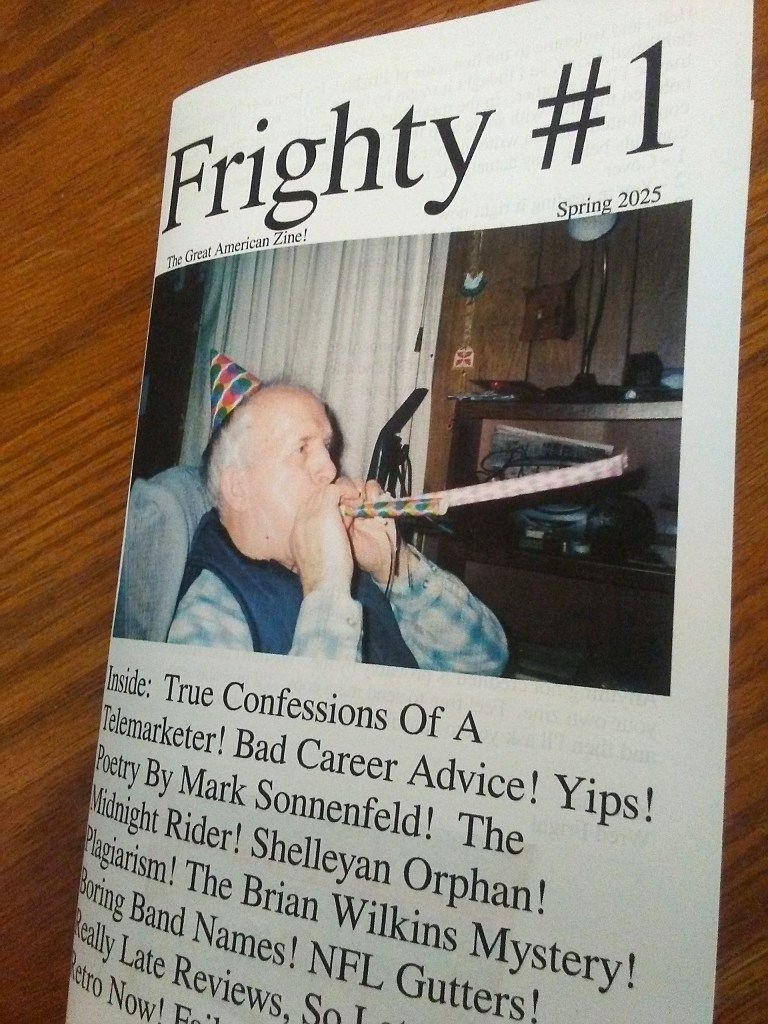
PRINT-ZINE REVIVAL?
HAVE DIY and analog returned? Why not! Grass roots Do-It-Yourself art has always been the best answer to the monopolistic-conglomerate domination of our culture– among the worst offenders in that regard being publishing’s Big Five.
Authentic culture is organic. Always has been. We’ve had a glimpse of this recently via the Bob Dylan biopic “A Complete Unknown,” whose focus was the folk music revival of the 1960’s. One of the roots music pioneers depicted was Woody Guthrie.
Roots literature has had its own pioneers, among them the writer-chronicler known as Wred Fright, a key voice and thinker during the zine heyday of the 1990’s and 2000’s.
The latest news: Wred has produced his first zine in years! The start of a zine revival? We hope!
Information on easily obtaining the zine, Frighty #1, is available right here.
NEW FICTION

Despite the lingering sense that he’d been conned, duped, or sold a bill of goods – the exact term depended on his feelings at a given moment – Jeff found himself not merely adjusting to Southern California life, but actually enjoying it. Having lucked into an apartment a block and-a-half from the beach in a still somewhat funky part of Venice, he loved the climate, which allowed him to run or bike at dawn on Ocean Front walk without encountering sleet, hail, or horrendous humidity. He got a kick out of being in a place that had more yoga teachers than Mumbai, as well as ubiquitous Pilates studios, gyms big and small, and even a place called Stretchlab. And he marveled at the restaurants catering to diets unheard of on his home turf. Though he had encountered vegetarian before, he hadn’t been aware of Ethiopian vegetarian, or multiple examples of paleo, keto, gluten-free, Atkins, plus something called Zone.
As for the infamous LA traffic, it only became a bother when, in a used Camry that made his cousin cringe, he had to make an emergency run to Children’s Hospital on the eastern edge of Hollywood.
In the low-rise Santa Monica office he shared with his cousin, the division of labor was clear. Steve treated the offspring of the “high-ranking industry folk,” while Jeff tended to the sons and daughters of what were termed “the civilians.”
That, Jeff quickly came to realize, meant that he was spared the fawning, pandering, and indulging that Steve felt provided the pathway to the success.
COMING SOON to New Pop Lit!
