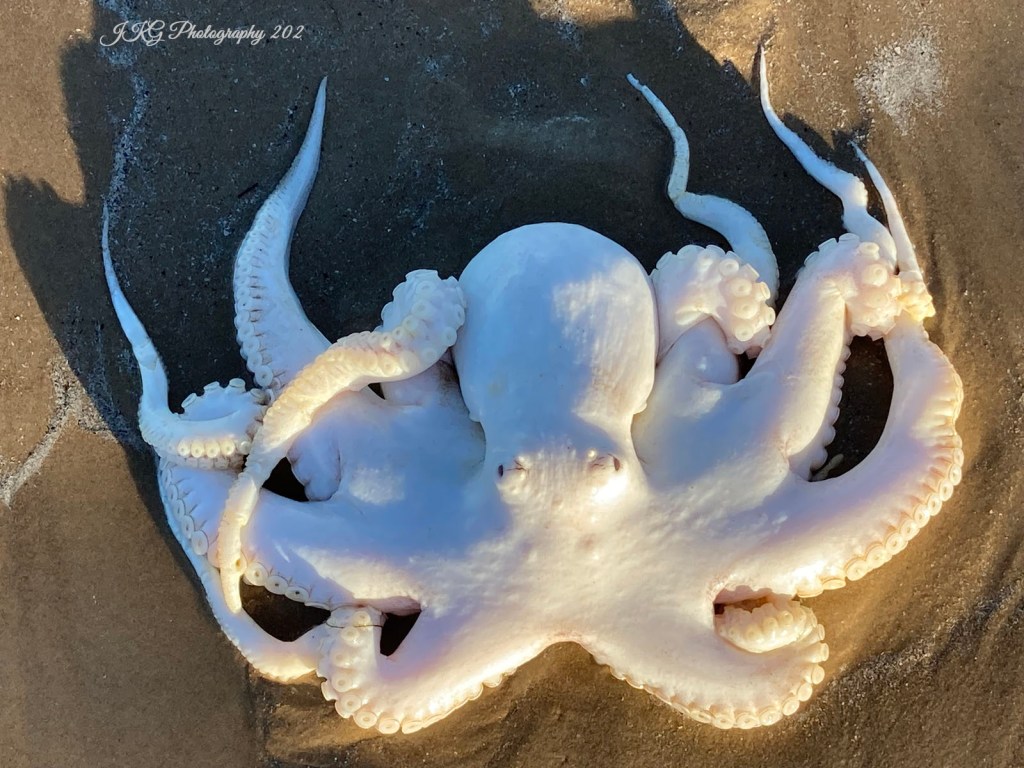

Creature from beneath the waves Made its way through the turbulent ocean surf To die drowning in the sharp air of our windy shore
The giant Pacific octopus is five feet long Its skin is white and its huge eyes blue I feel desperate to save it But when I circle it in my arms to carry it to the water Its proper milieu in life I find a mortal wound on its underside Blood not red, but blue, leaks quietly
Do its three hearts throb with love and fear of death? How do I comfort it in its departing moments When it is so foreign and its habits solitary?
Ten days before Dave died Cancer having stripped him of flesh and height We stood hugging each other deeply And I whispered the volume of my love. I knew how to comfort him. In that moment No otherness divided us.
Julia Piehler authored our previous poem at Fast Pop Lit, “A Rose Dance.” We’ll be presenting one more poem of hers here– as lead in to our next feature at our main site.
C. Ryan: AfterLife is truly groundbreaking, not just on a technological level, but on a philosophical one too. Individuals can set up profiles at any time in advance of their passing, the earlier the better. By feeding in text logs, emails, and even phone recordings, we can replicate the conversation patterns of the user such that, after death, they can continue to communicate with loved ones—at least as long as there’s a valid card on file. Now, you don’t have to say goodbye.
When she heard about AfterLife, Holly signed up immediately. It was almost a year since Steven died, and her life still felt as unmoored as it had in those first days. But the program promised connection, support, and most importantly, closure. She signed onto the computer that Steven had left—the only one they’d had in the house since she’d never really felt the need for one before—and made an AfterLife account. She checked off approval of the terms and conditions without reviewing the attached 60-page file. The portal prompted her to provide texts, emails, chat logs, phone recordings, voicemails. She didn’t have the password to Steven’s email, and she’d gotten rid of his phone, unable to look at it without thinking of the horrible messages he’d gotten from his classmates. So she provided what little she retained—a couple of essays he’d written for school gathering digital dust in the computer’s file folders, and some texts that she had saved to her phone, and she proceeded with a certain amount of hope that the program could still work the kind of miracle she’d been promised.
She quickly realized it was not to be. Her first message, delivered to her phone an hour after the algorithm had the opportunity to work over the data and establish a persona, left her cold, jaw agape at a text that had to be some kind of cruel joke.
Christabel is fairly sure she’s the wrong person for this particular job. They’ve hired her too early in the game to put her expertise to best use, and she’s a beginner at the kind of trustee-wrangling and civic politics that are currently underway. But thanks to common sense, an unusual accent, some acting experience, and decent clothes, she’s getting by. The trustees have abandoned the hare-brained idea of locating the museum up here at the house; they’re working out a deal with the people restoring a big old brick building in the middle of the city. People appear to be taking her seriously.
“You’ll be fine,” her mentor Peg in San Francisco had told her. “Mostly they need an authority to quote, so they can feel okay about their decisions. And face it, you need the dough, and you could use a summer away.”
All true enough. Adrian had just abandoned a book of his own, was going through what he gruffly called a “rough patch,” and had lately been leaking equanimity-threatening volumes of vitriol. A stretch apart might give them both a chance to catch their breath.
(Troubling that Peg had noticed, though. Had it been so obvious? Christabel hadn’t said a word.)
the one thing you should never fight is nature. if it isn’t meant to be why will it into existence? if it is meant to be why deny? it is a battle you will lose 9 times out of 10 and the one time that it tricked you into believing you won, it will haunt you like the carcass of a rotting pig.
***
Ken Kakareka has appeared numerous times at Fast Pop Lit.
His publication, Bullshit, is available at Amazon.
Father surveyed the garage. It belonged to his neighbor, the hippie who never locked anything and was away on a “Vision-something or other.” He scanned slowly left to right, then right to left, as an expression of forlorn resolve settled slowly onto his face. He took off an unkissed crucifix and shelved it between an ancient can of paint and a small wine press.
He made sure that there were no gaps around the garage door and put towels at the base of it to ensure there would be no leakage. He held a pint of sweet liquor he found in his neighbor’s freezer. As it thawed, an ice-cold tear drop ran down from the neck to his hand. He got in and started his neighbor’s car, choked down the pint and a handful of Ambien.
When he woke he smelled his former internal acids mixed with the sweet liquor, now rorschached all over his frock. He was not in heaven or hell, but the purgatory of a dreamer’s garage. The first miracle of his seventy years and a sign that the connection had been restored.
He shut off the Tesla, collected the towels and went back to his house.
Brannon O’Brennan lives in Northern Virginia, USA. His work has been published in Isele Magazine, Cinnabar Moth Literary Collections, and in The George Washington University Press. His literary fiction short story “Symbiosis” was published in Secant Publishing’s anthology titled “Best Stories on the Human Impact of Climate Change” and that story was nominated for the Secant Publishing Prize. He’s also have published a short story collection through Alien Buddha Press.
why is that dog biting its owner is it the chains and ropes that pull the shepherd to a suicidal thought or is it the man that harasses his friend to test if he can manipulate the docility of an animal but look the blood is pouring out like droplets of watercolor paints that used to impregnate my xs-sized tee and now it’s there but only darker and sadder i would laugh my stomach out when red pours out because it’s a dumb mistake but now why is the dog so unhesitant and merciless towards its owner the old man that walks it everyday cares for it baths it in the pouring rain despite his asthma and gives it a little bow in its chest is it tamed is it a disguised wolf why is it now lying on the floor growling rolling screaming and the man is running with crimson traces in his route and something in his hand like a folded story he wants no one to know about?
Bach Le is currently living and studying in Hanoi, Vietnam. His poems have previously been in Synchronized Chaos, Haikuniverse, and more. Through poetry, Bach hopes to give voice to different issues in society, as well as showing his attitudes towards life with its various dimensions.
He came because he had a “lump” at the injection site. I finally got him to pull his pants down, after I offered the usual bribe, turkey sandwich and a fruit cup, and I saw it immediately, an arterial pseudoaneurysm as big and red as a fresh plum. He missed the vein and damaged the wall of the artery. I touched it as gently as I could, and felt the blood pulsing through my gloves before he shoved my hand away.
“That fuckin’ hurts, man.”
“Look, Tim,” I said, hoping to scare him just enough to make him take it seriously, “you’ve got a weak spot in the wall of your femoral artery. It could rupture at any moment. If it does you’ll bleed out in a few minutes. I need to get an ultrasound of it and get the vascular surgeons to see you. I think you’re going to need an operation.”
“Just give me something for the fuckin’ pain,” he said, “and I want another san-which.”
I knew I couldn’t give Tim a sandwich. The surgeons were going to be mad enough about the first one, but I knew him well enough to know it wasn’t the time to explain or argue. That could wait until we figured out what to do. But Tim had a new nurse that day, and she didn’t know him, hadn’t learned how to redirect him when he started making demands. So, when he asked for ginger ale and she told him, in a matter-of-fact way, that we didn’t have any, he said “Fuck you, bitch.” He tore off his hospital gown and threw it at her. Then he stormed out of the ER, cursing us all the way to the door.
I could hear the storm outside in the night. But a crack in the fire told me I Am Here, and I remained on the couch. Warm. Safe. Secure. At last with my privacy.
I was in that blissful state of living with my mind dead when the knocking began. It took me a bit to come back here. To debt, betrayal, and aging. I thought it was either a tree branch or dumb animal at first. Banging against the front from the wind or instinct.
The continued knocking corrected me. And it just grew louder, refusing to follow any rhythm to let me nod back to daydreams. It was a noise outside my peace. And I could only grumble in anger. Did not this would-be Voorhees know how much I suffered? Did he not know how much I needed this little away from it all? Here I was; finally enjoying the solitude I’d been planning for months, and in the peace of near slumber comes this KNOCK KNOCK KNOCK.
The coffee-toffee-caramel of my hot liquid handwarm looks luscious. It is also the exact same hex-code shade as the last nub of supermarket mudcake, resting on an A4 exercise book receipt book book book poetry books to-do list book tower on desk. I gnaw and gobble at both, sticky fingers returning to the clacker palette.
It is the witching hour, ideal for tickling my muses. Beyond my window sash, distant cicadas float in the black pool of night.
This is an appreciation letter to all the owly writers chained to their desks: your lit mag publications will fill up your bios but not your growling hearts (or egos). Get yourself a friend not for listening to you air your novel ideas or read at that gross anarchist bookstore, no. Someone who likes talking to people at the park, believes life is good and yes, helps you unclench so the words finally start flowing from your lips.
Touch grass. Get stung by a wasp. Bite the sun.
Haoyi Zhang is a reluctant student at FASS USyd and hopes to poem good for Cordite one-time this livin’. Drag them out for kebab + walks. Off all socials except Discord: @open_far
1.) Have you known women like the character in your story, “Straight and Narrow”?
I think everyone shares morbid desires similar to the woman’s, whether we admit to it or not. Certainly I see myself in her just as much as I do in the narrator. But do I know anyone who has gone out and done what she’s done? I don’t think so. Though, I guess, who’s to say? Perhaps I do and I just don’t know.
2.) Who are your favorite writers, present or past?
Rebecca Curtis is one of our best living writers, in my opinion.
Other writers I return to often: Barry Hannah, Amy Hempel, Mary Gaitskill, Denis Johnson.
Also, Amie Barrodale’s collection is perfect.
3.) Have you written a novel, or do you plan to?
I’m a little superstitious and so all I will say is: Yes. If nothing comes from it, I’ll trash it and try again. And then again? And then again? Probably one day I’ll give up actually. Maybe get into gardening. Birdwatching.