NEW POETRY

(image c/o thetileshousedotcom)

Iliria Osum is an interdisciplinary artist who lives and works on unceded Kumeyaay land in Southern California. Find more on Patreon.
NEW POETRY

(image c/o thetileshousedotcom)

Iliria Osum is an interdisciplinary artist who lives and works on unceded Kumeyaay land in Southern California. Find more on Patreon.
NEW FICTION

Basketball basketball basketball. We sit in class all day thinking about it, then practice for two hours or maybe have a game, and drive home talking shit about who busted who, and I drop ’em both, Higgins and Sonny, in a fucking trailer park. And though my father’s life insurance got us a house—split level ranch in the center of Freetown—the place was too big for us to heat, half the rooms sealed closed with plastic. Every day same as the one before, until Coach comes up to me after practice and asks if everything’s okay and I say Sure, why wouldn’t it be? And he says, You’re not playing like yourself, keep it up and you won’t get a scholarship, and I shrug my shoulders, thinking, Fuck a scholarship, and take Higgins and Sonny home to the trailer park and go driving.
It’s another of those cold gray East End days when I pull up to the first beach, Maidstone, only half mile or so from home, and see this figure standing out at the end of the jetty that sticks into the harbor, wearing this purple hat and scarf. On days like that everything blurs into gray – water, land, sky—except now there’s these two soft spots of color. Then the figure holds its hands out to the side and turns slowly in a circle, and I realize it’s Joany. She spins again and I can barely make out her mouth is moving. I roll down my window but the wind is whipping in off the water too loud to hear anything, yet I see the headphones poking out beneath her hat and her mouth opening and closing like she’s singing. Hasn’t said a word to anybody in almost a year and she’s standing out there on the jetty singing.
COMING SOON to New Pop Lit!
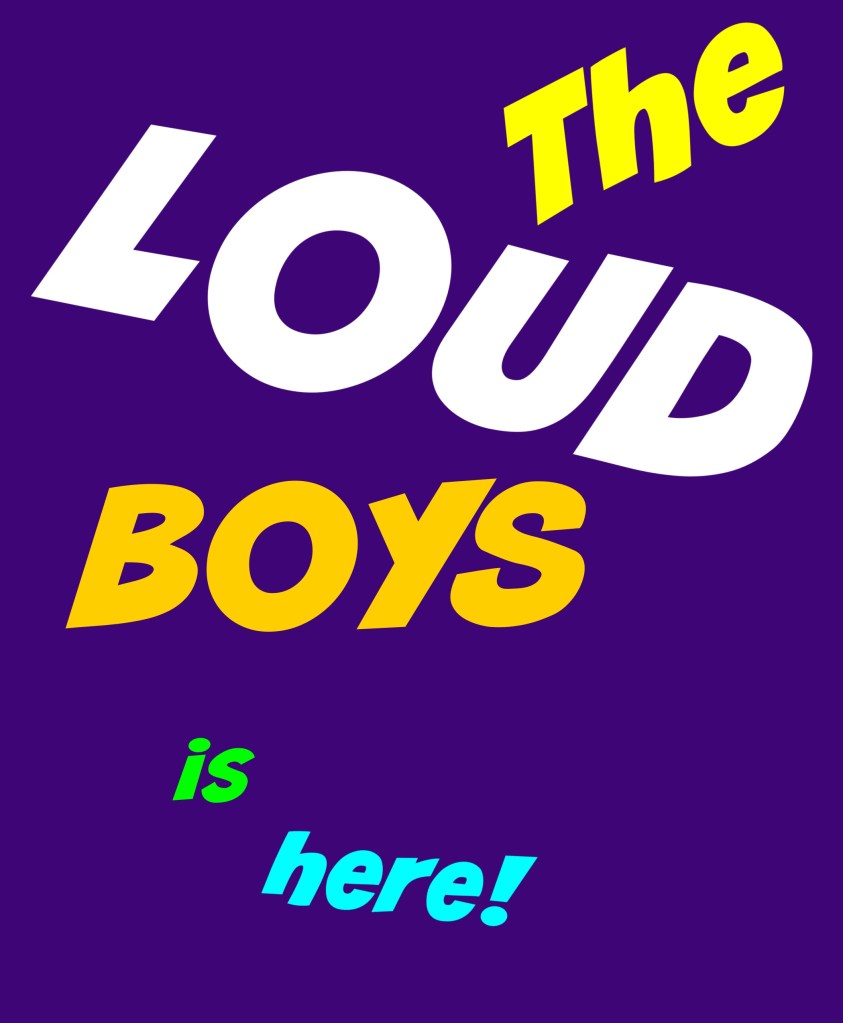
AN EXCERPT FROM THE LOUD BOYS

As Van made preparations, his new business partner, Fake Face, attended a charity event in a well-guarded suburban enclave, repository of most of the area’s remaining wealth, much of it held by the progeny of deceased industrialists. His smiling rubber mask fit well with the artificial smiles and insincere greetings of other donors. The fundraiser was at a local art gallery. The gallery’s current exhibition was titled “Connectivity”– partly financed by a grant from a Fake Face tax shelter. Fitting the theme, electrical cables spread across the floor like black snakes, connected to strange-looking purple steel machines and giant video monitors displaying the latest in certified NFT art.
“EMBRACE THE CHAOS”
flashed on and off in lime-green letters on a large electronic screen in the ceiling. “We’ve blown the building’s circuits three times already!” the gallery’s curator in a near corner bragged to a circle of wealthy patrons.
“Oh! So glad to meet you again!” a wealthy blonde matron of fifty gushed to Fake Face– they’d met previously at a fundraiser for an animal shelter.
The woman’s ninety year-old husband had recently died, leaving her his fortune. Money to spend and time on her hands. She’d had plastic surgery– her cheekbones were ridiculously pronounced, turning her unobservable eyes into narrow slits. Her lips were swollen balloons. Her skin had the consistency of wax. Both obscenely rich individuals who’d made their wealth in mercenary ways peered dutifully at slabs of AI-generated artworks adorning the walls: either meaningless black-and-white blips and blots, or colorful scenes from unproduced cartoons, with the exaggerated glowing plastic quality of all such AI concoctions. Images of inhuman red-purple-blue figures with distended forms and exaggerated eyes. Illustrations for a madhouse. Mirror reflections of the crowd.
The pricey gallery was an island of insanity in a sea of tragedy.
When Fake Face turned to speak to the woman, she saw his shifting eyes and sensed his real face behind the rubber facade, smelling his sweaty intensity.
!!!
(Based on real happenings? The Loud Boys is now available via Nook, Kobo, and Kindle. A paperback version is coming.)
ABOUT 3-D THINKING

IS multidimensional fiction too far ahead of the crowd?
Possibly– as our brains have been wired from Day One into linear, two-dimensional thinking. The most lauded novelists– William Faulkner to Don Delillo– simply give us more of it: longer and longer sentences and paragraphs as the reader burrows ever further into the narrative. The text. Which has its appeal, no doubt, but shouldn’t be the only standard of value for literary products like the short story and novel.
One of the reasons perhaps why Aben Kandel and James Gould Cozzens are kept out of the canon is because their best novels– City For Conquest and Guard Of Honor respectively– are, at their core, multidimensional in design and effect. They throw entire worlds at once at the reader. Many of our best-trained literary experts and commentators can’t handle it.
NEW WIRING
The foundation of multidimensional fiction is 3-D Thinking. The ability to perceive and understand all sides of an issue, simultaneously.
Think of driving a car and seeing, directly and peripherally, everything happening around you. That person on a bike, on your right. Another person further ahead crossing the street. A speeding car passing you on your left, moving into your blind spot. Another coming up fast in your rear view mirror.
Unfortunately, most people driving on our streets have tunnel vision. Stand on a street corner and watch them. They stare straight ahead, oblivious to anything going on except that which is directly in front of them.
Or they’re staring at their smartphone.
3-D Thinking, by definition, also means increased compassion for other humans and their struggles, wherever they’re placed in society’s hierarchies. Not always easy to accomplish!
IS rewiring your brain worth the effort?
THAT’S the question. One I attempt to answer with my new novella, The Loud Boys, now available in ebook format at Amazon here, and at Kobo, here. (Print version coming soon.)
-Karl Wenclas
–and their potential influence on literature.

Graphic novels and comic books aren’t taken seriously by literary people, even though they’re an offshoot of the novel (19th century melodrama; early 20th century pulp fiction), and are a gateway for many readers to the novel.
The basic building block for the narrative comic book is the panel. Mini-paintings or portraits, usually with words added. When they’re not, the stand-alone illustration is meant to make a point– to emphasize a key plot moment, even depict the story’s climax. The result: interconnected micro-chapters. Dialogue is used sparingly but well. The graphic novel embodies the principle of “less is more.” A single sentence or lone illustration carries meaning beyond itself. The technique works on not spelling everything out. On not having to spell everything out, a principle used first by impressionist painters, impressionist music composers like Debussy, and by 20th century modernist writers Georges Simenon and Ernest Hemingway.
“It wasn’t by accident that the Gettysburg Address was so short. The laws of prose writing are as immutable as those of flight, of mathematics, of physics.” -Ernest Hemingway
Ernest Hemingway was heavily influenced by Impressionist painter Paul Cezanne. Like Stephen Crane, Hemingway saw literature as a visual art.
USING THE TECHNIQUE
JUST AS the comic book/graphic novel was an outgrowth of popular novels, there’s no reason why serious fiction writers can’t in turn be influenced by the graphic novel. “The graphic novel without graphics.”
Ways to do this:
1.) More striking, over-the-top characters.
2.) More dramatic plots.
3.) Short mini-or-micro chapters, to emphasize each plot moment– and to keep the narrative moving at a faster pace than traditional literature. All part of what I call multidimensional writing.
ADVANTAGES OVER GRAPHICS
What graphic novels can’t do is get inside the heads of their characters. This can be used in multidimensional writing, as in traditional fiction, without going full Henry James-Virginia Woolf “stream of consciousness.” One of the failings of contemporary writing is the trend toward alt-lit/autofiction-style solipsism, which often as not cuts out the actual world: the tragedies and happenings of now. Which is a shame, given today’s contentious chaotic happenings begging to be intelligently addressed with understanding, compassion and outrage.
One of the strengths of multidimensional fiction is the ability to present a variety of viewpoints, quickly switching between them for a rounded, three-dimensional effect.
As we’ve begun doing with some (not all) of our writing. Including the just-released novella, The Loud Boys— now available in ebook form at Amazon. Print version coming soon.
-Karl Wenclas
AN ANALYSIS

THE PART of the literary game up for grabs should be obvious, but it’s not: non-readers. Many millions of people who can read, could be reading, should be reading, but aren’t. The outfit which figures out first how to reach that crowd, that demographic, will own the future of the literary business.
A model to follow exists: the rock n’ roll music explosion which began in 1955 with the success of the 45 rpm single “Rock Around the Clock” by Bill Haley and the Comets– which dropped like a thunderbolt into an era of bland pop music sung by the likes of Patti Page and Perry Como.
At the forefront of the early rock movement were a handful of low-rent hustlers: Alan Freed in Cleveland; the Chess brothers and Chess Records in Chicago; Sam Phillips and Sun Records in Memphis; and soon enough, Berry Gordy Jr. and Motown Records in Detroit. Within a few years, they and other indie labels took half the record industry’s market share away from the monopolistic “Big Four”– and sent the cultural world into shock.
Over the next fifteen years the record industry multiplied several times over– due largely to new listeners. Popular music became the indispensable art, a part of most people’s everyday life– even part of their being, instead of existing as a distant icon on a pedestal, to be observed from afar and admired.
A key stat: in the mid-1950’s the jazz and classical music genres, sustained by the “close-listening” crowd, each held about 20% of the record market. By the time the musical revolution was over, their shares hovered closer to 1% each. They held their fan bases– but played no role in grabbing new audiences. The difference between a static and dynamic art.
THE LESSON?
The lesson is that cultural opportunity is always out there, but you need to be willing to grab it. To open the door to the new and exciting– or bust open a door if one isn’t there. Opportunity is greater with an art that’s long remained static, as in the literary field.
At New Pop Lit we’ve worked intensively at developing new models which potentially can wake up the non-reading public. That enormous untapped market. Our latest experiment is a novella which combines pop, noir, adventure, satire, topical politics and a comic book vibe: The Loud Boys. Ebook soon available at Amazon, with a print version to follow.
TWO QUESTIONS
1.) Are our literary experiments worth the attempt?
Absolutely. The upside is enormous.
2.) Am I pandering to the audience by writing “pop” style fiction?
I’m not pandering. I am that audience. I was an enthusiastic reader long before I thought about being a writer.
-Karl Wenclas
NEW CHRISTMAS POETRY

The Christmas I got Abbey Road
I also got my first typewriter.
I knew then only that something
was supposed to happen. I sat
near the fire all day.
COREY MESLER has been published in numerous anthologies and journals including Poetry, Gargoyle, Lunch Ticket, Five Points, Good Poems American Places, and New Stories from the South. He has published over 45 books of fiction and poetry. With his wife he owns Burke’s Book Store (est. 1875) in Memphis.
FLASH FICTION

(image c/o dixiecrystalsdotcom)
The red painted sign staked into the grass beside the stoplight just off the highway exit said “PIE SALE,” and the rich man followed it in the direction indicated until he came upon a long table stacked with pies set up in front of a modest little slab ranch. Behind it, a woman wearing a house dress sat holding a small metal cash box.
“I’d like to buy a pie,” the rich man said, approaching the table, “but I don’t have any money.”
“Sorry,” said the woman. “No free pie.”
“Funny,” replied the rich man. “That’s the same thing your mom said to me last night when I picked her up under the Ninth Street bridge.”
“My mother’s dead, you pig!” gasped the woman, and without further ado clobbered the man right in the face with a pie.
“Yum, yum,” he said. “Free pie.”
And now we know how that man got so rich.
***
Eli S. Evans publishes his absurdist bits and bobs all about the internet. In addition, two books of small stories, Obscure & Irregular and Various Stories About Specific Individuals in Particular Situations, have been published by Moon Rabbit Books & Ephemera. Buy one! Buy both!
NEW FICTION

One of the pleasures of being a family physician was watching people grow and develop. I tried to help them along the way from cradle to adulthood and the grave. They have given much back to me. I have learned from them. I got meaning.
I learned that people with autism sometimes are blessed with special gifts. They used uncharted areas of the brain to amaze and fascinate.
Sarah taught me about the weather. She focused on the highs and lows of the day. She could predict it. I was not sure how she did it. I suspect it had something to do with her innate sensitivity to circadian rhythms, bariatric pressure, or the phases of the moon or something, but her predictions were so accurate that the local weatherperson would call her to confirm and compare notes before going on TV with a forecast.
Her reputation spread until all three local networks consulted with Sarah before going on air.
Sarah would put her hands on the window and, through touch, would divine temperature and humidity. She was correct. I tried to do it. I was always wrong. I functioned poorly in her world.
COMING SOON TO NEW POP LIT!
A RANT

(photo of chateau d’if prison c/o travelfrance)
We’re imprisoned by our own attitudes.
We’re held back by the preconceptions, prejudices, and stereotypes with which we address the world. They become invisible jail bars around our minds. We construct a fortress around our accepted ideas– stone walls that an army couldn’t break through.
One sees this in every aspect of life– including in the literary realm. Writers and critics cling to rules laid down sixty-four years ago by a handful of intellectual pundits, most notably Dwight MacDonald in his 1960 Partisan Review essay, “Masscult and Midcult.”(An earlier essay by Clement Greenberg in the same publication, edited by Dwight MacDonald, set the tone.)
UNBREAKABLE RULES:
No Kitsch! Whatever kitsch is. Anything which might entertain the public.
Beware the Public! No masscult, midcult, on the edges or in-between.
Allowed: Completely inscrutable, alienating, pretentious and goofy examples of upper-class overeducated posturing known as the avant-garde.
Whither the fate of the prisoners of Dwight MacDonald?
They sit cautiously in their antiseptic modernist-designed offices and rooms. No art adorns the walls– only a single beige baize stripe (the walls themselves are gray) in the style of Barnett Newman, and a distorted portrait of a sparrow, meant to symbolize one of their captured-behind-glass idols, Proust.
The prisoners wait for: something. Not commutation of their sentences. They love their sentences– both kinds. They sit carefully at cold metal tables writing sentences on laptops, well-written one-direction sentences– always very well written, carefully screened: they rigidly police this– more and more sentences, always more of them, long ones, jammed impressively together in ever-longer paragraphs on more and more pages– Infinite Graphomania– and the sentences are acceptable if they’re intellectual, not passionate or emotional; not too much plot or excitement; no outbursts or melodrama– that would be kitsch– the sentences are permissible, approved, allowable, laudable just as long as they don’t engage the stray incautious reader in any way.
-Karl Wenclas
(These thoughts to appear someday in a planned book on the technocracy.)